I have arrived at the Podgorica bus station to get a bus that will take me all the way to Kosovo. Of course, just like anywhere else in the Balkans, I had to pay a station fee to enter the platforms the buses depart from. A small shuttle is already waiting, and I take a single seat. A guy who looks like my former colleague F is sitting in the seat in front of me.
I am completely unaware of how wild that ride will be.
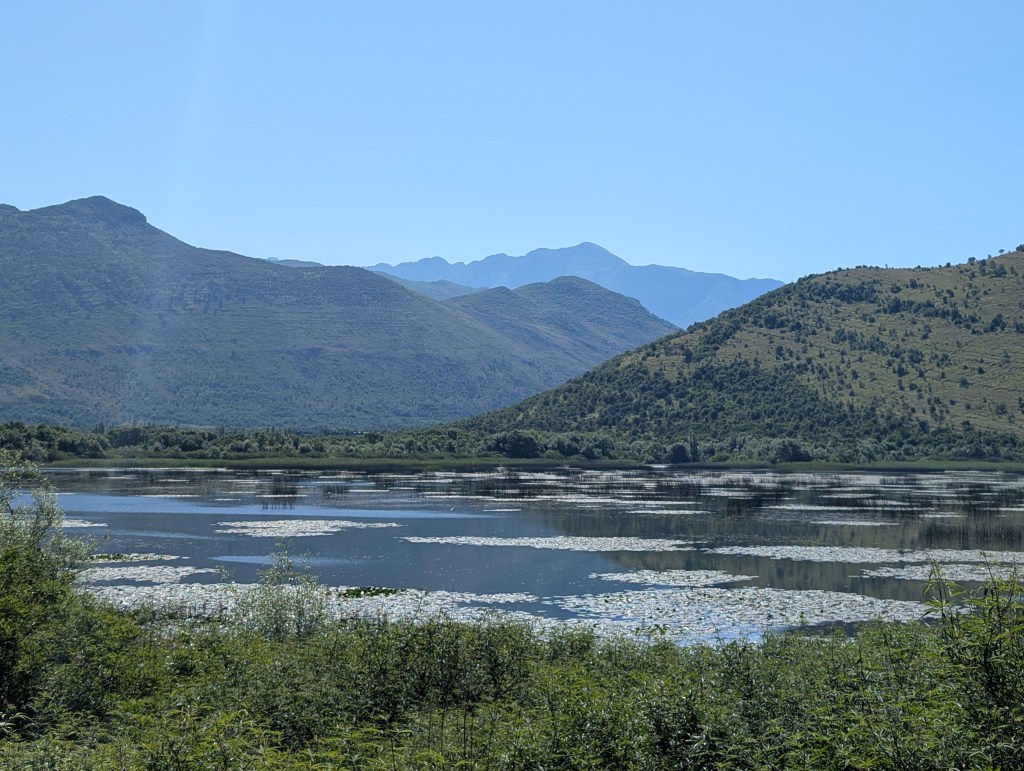
The route of the bus leads through Albania, which means we will have to cross two borders. The first one is as easy as pie, a regular procedure, get out, show your identification, walk to the gate at the other end, show your ID again, get in. Less than thirty minutes into Albania, the half-empty van stops at a petrol station to pick up more passengers. Among them there is J, from Germany, who is travelling with his Thai sidekick. J informs us that Kosovo will be the eighty-sixth country he’s visited. He is a development manager for some global travel agency, so each year he spends six months travelling to set up branches in many far-flung corners of the world.
And then there is another J, a young guy with confidence I have never seen in a person before. He’s got a Swedish passport, but is of Chinese descent. A practicing Muslim (but not an Uyghur), he is a student at some California university. What is this combination?! Sixty six countries visited, he is puffing on a vape that can’t possibly contain only nicotine. We keep talking all the way to the next rest stop, where we scatter around to find some food. Me and the Swedish J find excellent food in the restaurant at the petrol station, a buffet with hot dishes, just get a tray, some cutlery, a plate with a serving of tomato-based Balkan goulash, yummy.
It’s also where we get separated. Me and the guy who looks like F are put in a bigger bus that somehow joined us during the break. Our baggage? I ask, and my new travelling companion concurs, can we move our baggage to the big bus?, but the driver just waves at us and pushes us towards the larger vehicle. Ok then, I just hope I will still have my bag when I get to Prishtina.
We sit in the only available seats, and I start talking to the fake F. Turns out his name is E, he is Turkish, and he spent some time in Poland as an Erasmus exchange student. If I understand him correctly, his sister is now doing the same. We go through the usual Polish topics, kielbasa, pierogi, zubrowka, zapiekanka, of course he knows them, his Erasmus stay would be pointless without being exposed to our national…
Tap, tap, tap.
I am sitting right below the place where the bus AC is dripping. It’s not a few drops, either, it’s like a neverending trickle hitting my shoulder and then flowing down my right arm. I am ready for any eventuality, so I put on my jacket. It’s not a proper slicker, but it should give me enough protection for the rest of the trip. The AC is broken beyond repair, though, and soon it’s my jacket, my arm, even the small of my back, that are soaked. The conversation with E is helping me ignore this little flash flood torture, and it can’t be too far until we get off at the second border, right?
Out of a cold shower, and into a sauna. Both the bus and the minivan where our luggage is travelling are stopped for a random baggage search. We are reunited with the two Js. The Swedish one is still puffing on his vape, going as far as to offer a hit to border control officers. He keeps joking, he finds everything amusing, he doesn’t stop talking. He is like Will Kassouf of backpacking, but much nicer than Will, with an aura of invincibility surrounding his chubby body.
Meanwhile, I get into a discussion with the guy searching my bags.
Are you carrying any weapons?
No…?
What about illegal drugs? and I really want to be a smartass, ask J, he is mighty chipper, but instead my answer is a resounding No.
Then what about this? the guy points to a box of activated charcoal capsules. He starts opening the box, taking the blisters out, he sniffs at both the paper and the aluminum wrapping, he tries reading every little word on the white-and-green package.
It’s for my stomach, you know, food poisoning, but he is not convinced. It takes him about five minutes to let it go, and he completely disregards boxes of mirtazapine I am also carrying. What the hell was that, I wonder. He probably needs to show how busy he is, you know, for his superiors, says the Swedish J cheerily.
And then we wait, 30 minutes, an hour, an hour and a half. It’s sauna time outside, hot and humid. Being in the shade does not help too much; at least me and E eventually reenter the minivan, but it doesn’t last long. Twenty kilometres later, we are put on the bus again, having to say our goodbyes to J the German and J the Swede (in his case, it wasn’t a goodbye, but more on that in later posts.) The Js are going to Prizren, me and E are travelling on a big bus directly to Pristina.
The AC still doesn’t work properly. No more dripping; some people took cabs at the border and we are able to get seats that are not retrofitted with a shower. But the inside of the bus does not cool down as much as it should. We are both tired, it has already been eight hours. It feels like forever, but soon we are at the Pristina bus station. We find a public transport stop and board a city bus. E gets off early, and I get taken for a ride to a part of town that is far away from the hostel. When it rains, it pours. After switching buses and a fifteen-minute walk uphill (plus three flights of stairs), I end up at the hostel. Fucking hell.
Over the next three days I have a chance to realize how different Kosovo is from other Balkan countries, especially Serbia. Kosovo is like little Albania – its main religious group are Muslims. And I have come to Pristina right in time for Eid al-Adha. Everything is closed, but not my 24/7 grocery store around the corner, and not some restaurants in the city center.
What strikes me most is the veneration that Americans get here. Reviled in Serbia proper, in Kosovo they are seen as saviors. There is a historical precedent for that, and it is yet another angle of the bloody Balkan conflicts of the nineties. In Sarajevo, I realized how tragic an insufficient military response of the West was, vis-a-vis Srebrenica. What was a complete failure in Bosnia didn’t happen again in Kosovo; the NATO reaction was swift and brutal, therefore guaranteeing Kosovo’s independence from Serbia.


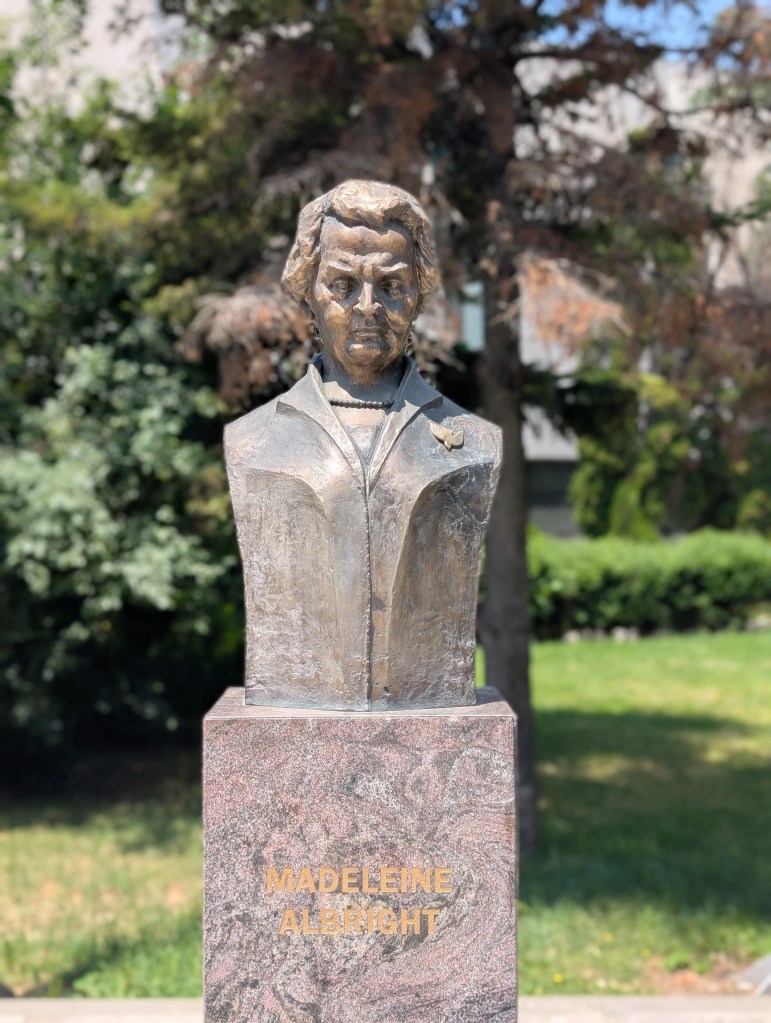
Many landmarks were erected to commemorate those events. Bill Clinton is waving at me from a pedestal in the city center, the Kosovo flag spread out on the billboard behind him. And the name of a boutique shop nearby? Yeah, you guessed it. Hillary. And then there is also Clinton’s avenue, as well as the avenue of George Bush. Madeleine Albright’s bust looks at me sternly, a stunning resemblance, the sculpture is almost like her real-life counterpart.
It isn’t just about famous historical figures. The Americanisation of Kosovo is visible everywhere. A picture of the pacifist memorial with kids’ paintings hanging from the fence has the Burger King’s logo in the background. A private school I’m passing by is called Princeton. There are cultural references to the USA at every step, every alley, every corner.

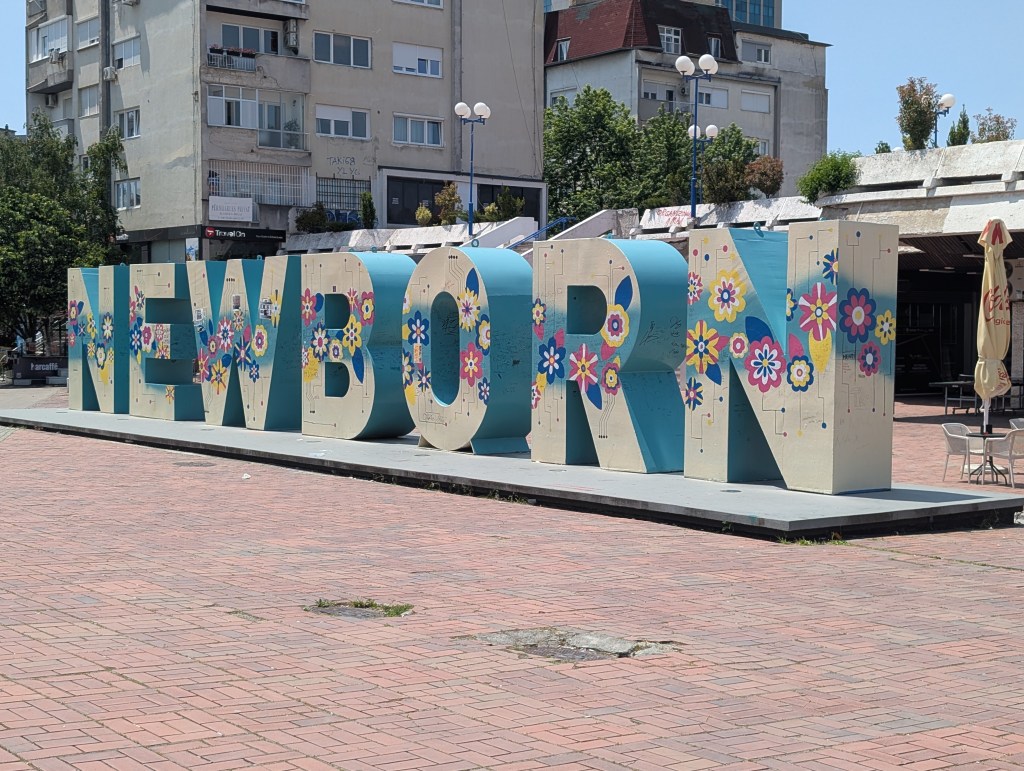
Pristina is also home to a large Catholic cathedral, despite Catholics making up less than five percent of the city’s population. But that’s understandable, here, in North Macedonia, and of course in Albania proper, Mother Theresa of Kolkata is celebrated as a saint, despite not being a member of the region’s predominant religion. I ride up to the top of the bell tower and see a city developing fast. I guess it’s a part of Kosovo’s drive to be unlike some of its neighbors. They want a clear separation, they desire more resemblance to Western Europe, their goal is to be a part of it. It’s like that sign in the city centre, NEWBORN. It has nothing to do with (the lack of) women’s reproductive rights. Instead, it’s a reminder of a country risen from the ashes to make its own story, follow its own path.
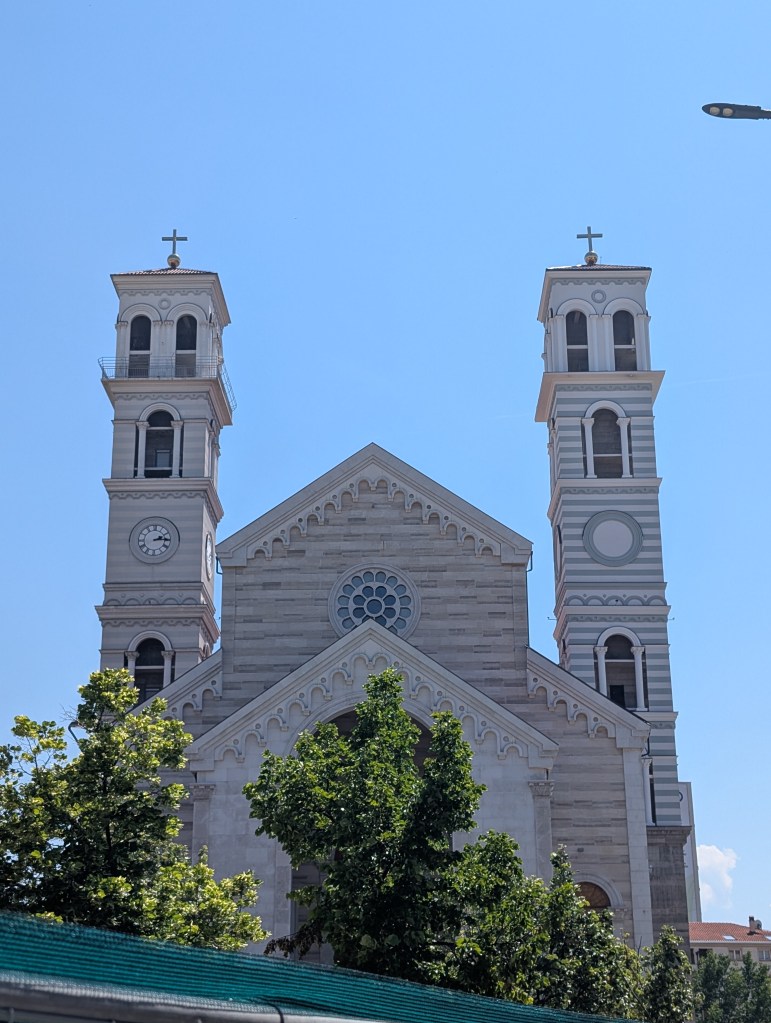
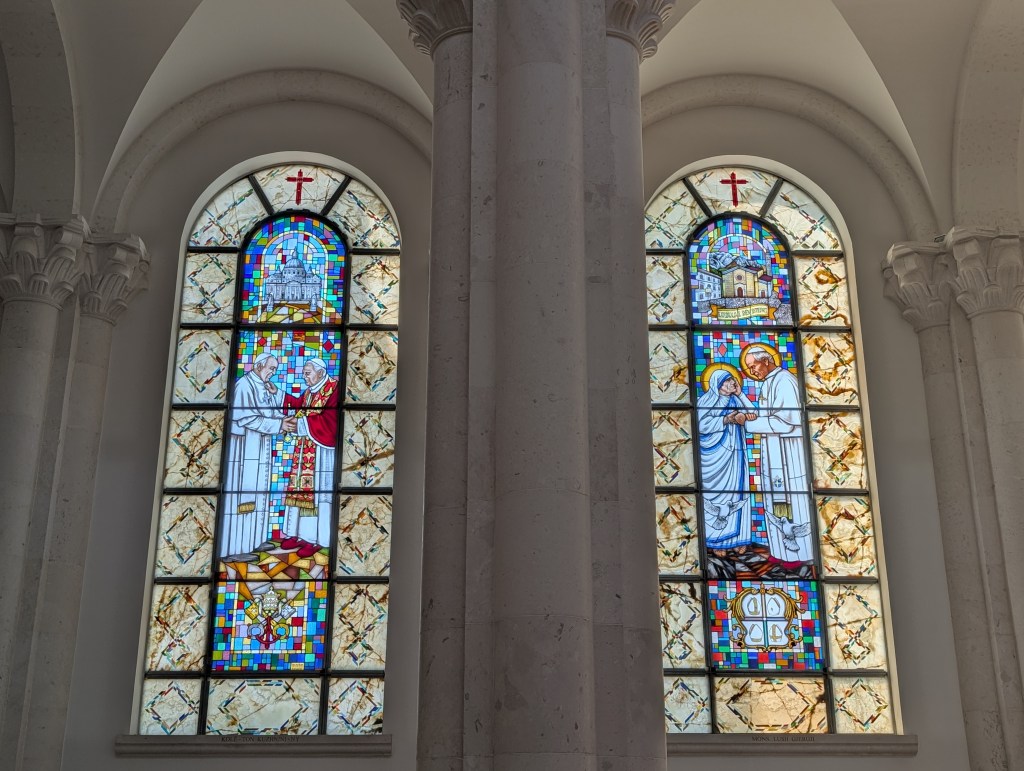

On the other side of the bell tower, I see a disgusting building of the public library. The architect must have been a drunken cynic, but hey, at least now he’s famous, it doesn’t matter that it’s for all the wrong reasons.

I spend my last evening in Pristina talking to M (from Albania), and a Jordan medical student whose name I don’t remember. The student leaves pretty soon, the conversation with M is chaotic, but in-between all the chaos I also find it uplifting. We talk about war, differences and similarities among nations, we talk about how hearing the music of Chopin in the most random of places makes my eyes well up. Chopin understood, says M, we understand. Just don’t use my name, he adds, and I am happy to oblige. Except for very special cases, I don’t use more than the first letter of my travelling acquaintances.
On the day of my move to Skopje, I experience another Google Maps-related debacle. I enter the bus that is supposed to take me from the hostel to the bus station. I am an insouciant guy, I am completely oblivious to the fact that I am slowly approaching the city border. It’s a thirty-minute walk in the scorching sun; I’m lucky I left the hostel early. By the end of the walk, I really hate myself and everything about the trip, it’s one thing to go with my little Osprey bag, and an altogether different one to carry all of my luggage in thirty five degrees without shade or water.
Back in the city limits, what do I see? The same goddamned bus arriving from the direction I’ve just come from. I guess it WAS going to the intercity bus station after all…
The paradox of travelling is that many of those stories are unbearable when they happen. Moments of elation are mixed with moments of complete despair. But wait for a few hours, a day, a month, and even the worst ones become anecdotes you happily share with your family, friends, people you’ve just met. Intrinsic beauty that we travellers only appreciate after the fact.
 Luke, around the world.
Leave a comment